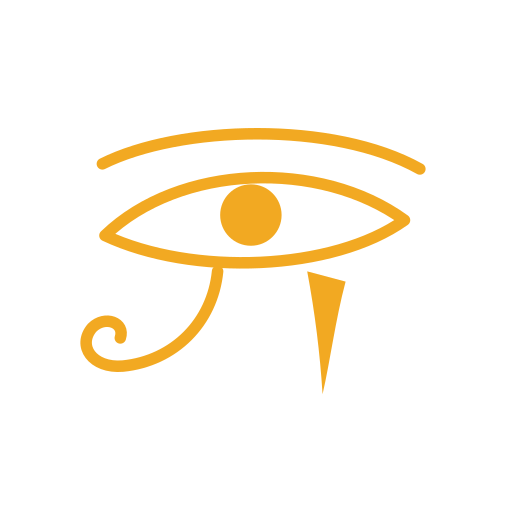
O olho de Udyat, símbolo do jogo, desenhado à mão a partir do Olho de Hórus.
Você já viu esse olho em tatuagem, em colar, em capa de disco e até em meme. Ele tem mais de quatro mil anos e
uma história de guerra, perda e cura. No Egito antigo ele se chamava wedjat (ou udjat),
palavra que quer dizer algo como "o que está inteiro", "o que está são". Em português e em espanhol ela também aparece como
Udyat, e esse é o nome do nosso jogo.
O olho que foi arrancado
No mito, o deus Osíris é morto pelo próprio irmão, Seth, que quer o trono do Egito. O filho de Osíris, o deus-falcão
Hórus, cresce e vai cobrar a dívida. A briga entre os dois é longa e violenta, e numa delas Seth arranca
o olho de Hórus.
O olho não fica perdido. Em uma das versões mais conhecidas, o deus Thoth (o da sabedoria e da escrita) recolhe os
pedaços e o restaura. Em outras, quem cura é a deusa Hathor. Por isso o olho virou sinal de
proteção, cura e recomeço: é o olho que foi destruído e voltou inteiro.
Um amuleto para os vivos e para os mortos
Os egípcios carregavam o wedjat como amuleto, feito de faiança, pedra ou ouro, para afastar o mal e proteger a
saúde. Ele também ia junto com os mortos, nas faixas das múmias, para proteger a viagem depois da morte.
Às vezes ele aparece ligado ao Olho de Rá, o olho do Sol. Os dois são parecidos, mas não são a
mesma coisa: o de Rá costuma representar a força e a fúria do Sol; o de Hórus, a cura e a proteção.
E a história das frações?
Se você pesquisar, vai achar que cada parte do olho valeria uma fração (1/2, 1/4, 1/8... até 1/64), usada para
medir grãos. É uma ideia muito repetida, mas os pesquisadores hoje discordam: o estudo de Jim Ritter (2002) mostrou
que essa ligação entre o olho e as frações é bem mais recente e frágil do que parece. Vale como curiosidade, não como
fato fechado.
Por que o olho é o símbolo de Udyat
Em Udyat — O Plano Astral, a cidade foi ocupada por construtos, os Decaídos. Você é um Mago
Onírico: chega ao Plano Astral sem nada, só com magia. Quem você derrota não some; você pode converter e
trazer para o seu lado.
É a mesma ideia do mito: o que foi quebrado pode voltar inteiro. O olho dourado é a marca dos Magos Oníricos, e o
dourado no jogo é sempre o seu, nunca do inimigo.
Nosso olho foi desenhado à mão a partir do wedjat, sem triângulo em volta (o olho dentro do triângulo é outro
símbolo, com outra história).
Esta é a parte 1 da série "A Jornada do Mago Onírico". Toda terça sai um novo passo da
jornada do herói, contado pelo mundo de Udyat. Na próxima: o Mundo Comum, a cidade ocupada.
Pinch, Geraldine. Egyptian Mythology: A Guide to the Gods, Goddesses, and Traditions of Ancient Egypt.
Oxford University Press, 2002.
Ritter, Jim. "Closing the Eye of Horus: The Rise and Fall of 'Horus-Eye Fractions'". Em: Steele, J. e Imhausen, A.
(orgs.), Under One Sky. Ugarit-Verlag, 2002. Olho de Hórus — Wikipédia.
The Journey of the Dream Mage · 1
The Eye of Udyat: where the Eye of Horus comes from
October 24, 2026 · 5 min read
The eye of Udyat, the game's symbol, hand-drawn from the Eye of Horus.
You have seen this eye on tattoos, necklaces, album covers and memes. It is more than four thousand years old and
carries a story of war, loss and healing. In ancient Egypt it was called the wedjat (or
udjat), a word that means something like "the whole one", "the sound one". In Portuguese and Spanish it
also appears as Udyat, and that is the name of our game.
The eye that was torn out
In the myth, the god Osiris is murdered by his own brother, Seth, who wants the throne of Egypt. Osiris's son, the
falcon god Horus, grows up to settle the score. Their fight is long and brutal, and in one of the
battles Seth tears out Horus's eye.
The eye is not lost. In one of the best-known versions, Thoth, god of wisdom and writing, gathers the pieces and
restores it. In others, the goddess Hathor heals it. That is why the eye became a sign of
protection, healing and renewal: the eye that was destroyed and came back whole.
An amulet for the living and the dead
Egyptians wore the wedjat as an amulet, made of faience, stone or gold, to ward off evil and protect health. It
also went with the dead, wrapped in mummy bandages, to guard their journey into the afterlife.
It is sometimes linked to the Eye of Ra, the eye of the Sun. They look alike but are not the
same: Ra's eye usually stands for the Sun's power and fury; Horus's eye for healing and protection.
What about the fractions?
Search online and you will read that each part of the eye stood for a fraction (1/2, 1/4, 1/8... down to 1/64),
used to measure grain. It is a popular idea, but scholars now disagree: Jim Ritter's study (2002) showed that the link
between the eye and the fractions is much more recent and shaky than it seems. Enjoy it as trivia, not as settled
fact.
Why the eye is the symbol of Udyat
In Udyat — The Astral Plane, the city has been occupied by constructs, the Fallen. You are a
Dream Mage: you arrive in the Astral Plane with nothing but magic. Those you defeat do not just vanish; you can
convert them and bring them to your side.
It is the same idea as the myth: what was broken can come back whole. The golden eye is the mark of the Dream
Mages, and in the game gold always means you, never the enemy.
Our eye was hand-drawn from the wedjat, with no triangle around it (the eye inside a triangle is a different
symbol, with a different story).
This is part 1 of the series "The Journey of the Dream Mage". Every Tuesday, a new step of the
hero's journey, told through the world of Udyat. Next: the Ordinary World, the occupied city.
Pinch, Geraldine. Egyptian Mythology: A Guide to the Gods, Goddesses, and Traditions of Ancient Egypt.
Oxford University Press, 2002.
Ritter, Jim. "Closing the Eye of Horus: The Rise and Fall of 'Horus-Eye Fractions'". In: Steele, J. and Imhausen, A.
(eds.), Under One Sky. Ugarit-Verlag, 2002. Eye of Horus — Wikipedia.